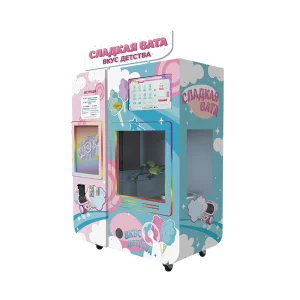
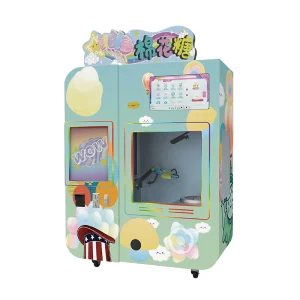
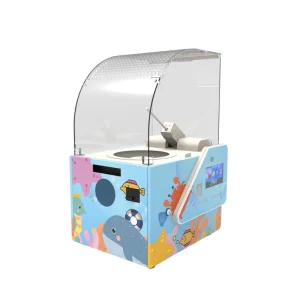
Industrial-grade, IoT-enabled food robotics engineered for 24/7 high-margin unattended retail deployment.
How autonomous robotics, computer vision, and real-time telemetry are redefining high-margin impulse sales across global commercial properties.
The commercial food equipment market is undergoing an unprecedented paradigm shift. Driven by structural shifts in urban commercial real estate rents, escalating labor overheads, and consumer demand for instant visual gratification ("eat-ertainment"), traditional manual food kiosks are rapidly being superseded by autonomous robotic vending platforms. At the forefront of this evolution is the global commercial cotton candy stand industry—transitioning from legacy, operator-dependent mobile carts into fully automated, cloud-managed robotic micro-factories.
For enterprise operators, shopping mall conglomerates, and regional vending distributors, evaluating OEM Cotton Candy Stands Suppliers requires moving past surface aesthetics to analyze core industrial capabilities. Corporate buyers are increasingly evaluating suppliers on four key technical pillars:
Mean Time Between Failures (MTBF) on critical sub-assemblies—including the high-rpm burner motor, automated stick dispensers, and multi-axis industrial robotic arms—determines field downtime and total operational profitability.
Enterprise deployments mandate strict electrical and food-contact hygiene accreditations, including CE, ETL, NAMA, RoHS, and FCC certifications, ensuring smooth customs clearance and insurance underwriteability.
Seamless API integration with regional payment gateways (Nayax, MDB protocols, credit card readers, QR code mobile wallets) coupled with cloud-based remote monitoring of raw materials, humidity, and sales analytics.
Why Guangzhou's specialized commercial equipment manufacturing cluster offers unmatched structural efficiency, rapid OEM customization, and cost optimization.
When sourcing commercial vending platforms, global procurement managers look to China’s primary hardware innovation hubs—most notably the Greater Bay Area (Guangzhou-Shenzhen Industrial Cluster). As a core manufacturer operating out of an 11,000 m² state-of-the-art facility, companies like Guangzhou Seven Cloud Technology Co., Ltd. (SevenCloud / Qiyun) exemplify how China's Industry 4.0 transformation directly benefits overseas buyers.
Unlike trading companies that white-label third-party machines, top-tier OEM factories execute full vertical integration across six key manufacturing stages:
| Manufacturing Dimension | Source OEM Factory (Industry 4.0) | Trading Middlemen / White-Labelers | Operational Impact on Buyer |
|---|---|---|---|
| Sheet Metal Fabrication | In-house high-precision laser cutting & CNC bending | Outsourced to third-party sheet metal shops | Consistent structural rigidity, zero chassis warping over prolonged transport |
| Robotic Core R&D | Proprietary patented multi-axis mechanical arm design | Generic off-the-shelf industrial parts integration | Higher movement precision, smoother flower-shaping routines, lower spare part costs |
| Burner & Thermal Tech | Closed-loop PID ceramic heating & moisture dispersion | Basic uncalibrated heating coils | Zero sugar clogging, consistent fluff texture regardless of ambient humidity |
| Quality Control Protocol | Rigorous 11-Step QC + 24-Hour continuous burn-in testing | Basic visual inspection before boxing | Drastically reduced Out-Of-Box (OOB) failure rates upon global arrival |
| Software & Firmware | In-house software team, OTA remote cloud updates | Static third-party software, no remote fix | Lifetime feature enhancement, rapid troubleshooting without engineer dispatch |
How commercial buyers tailor automated cotton candy stands for specific brand ecosystems, regional electrical grids, and localized payment infrastructures.
Commercial environments vary significantly between high-end shopping centers, outdoor amusement boardwalks, and climate-controlled indoor arcades. OEM engineering covers extensive physical modifications:
Unattended profitability relies on reliable software. Enterprise OEM solutions provide granular control over the machine’s operational parameters:
Strategic placement analysis demonstrating how autonomous cotton candy stands generate passive revenue across high-footfall venues globally.
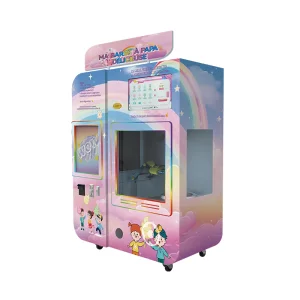
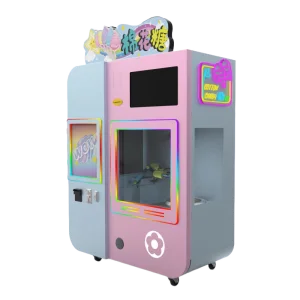
Placed near atrium escalators, children’s clothing corridors, or food courts. The vibrant RGB LED illumination and transparent glass window transform the spinning process into a live performance, drawing family crowds.
Positioned at ride exit queues, main walkways, and concession plaza zones. The automated machine operates continuously during peak festival hours without requiring staff break rotations.
Integrated alongside ticket redemption counters and claw machine zones. Accepts direct arcade card integration or token reader retrofits to fit existing venue payment setups.
An objective comparative financial analysis of traditional manual stands versus fully autonomous OEM robotic vending platforms.
In-depth answers to common questions regarding engineering, maintenance, customization, and global logistics.
Our commercial equipment holds comprehensive certifications depending on the exact model and destination market. These include CE marking (EU electrical safety & EMC compliance), ETL/CETL certification for North America, NAMA certification for vending hygiene standards, PSE certification for Japan, and RoHS/FCC compliance. Buyers are encouraged to confirm specific certificate requirements for their country during ordering.
The automated cotton candy vending machine incorporates a high-temperature automatic steam cleaning module for the burner and spinning bowl. It flushes residual sugar off the spinning head using controlled water cycles, preventing caramelization and sugar buildup. Additionally, an internal humidity monitoring system regulates internal temperatures to ensure sugar floss doesn't become sticky in humid climates.
A routine maintenance visit takes approximately 15 to 20 minutes. Tasks include wiping down the exterior glass, refilling the 4-color sugar hoppers, restocking paper sticks into the automatic dispenser queue, emptying the wastewater collection tank, and verifying overall machine operation using the onboard diagnostic screen.
Yes. We support MDB (Multi-Drop Bus) protocol standards, enabling seamless hardware integration with international cashless readers like Nayax, PayRange, and Ingenico. We can also integrate local bill acceptors, coin mechanisms, or custom QR-code API payment portals for specific regional banking apps.
We offer extensive customization across both hardware and software. Hardware vectors include full-body vinyl wraps, custom powder-coat casing colors, laser-cut logo lightboxes, specific input voltages (110V/220V), and modified cabinet dimensions. Software vectors include custom GUI screens, multi-language voice packs, brand video loading screens, and custom 3D sugar pattern programming.
We provide remote diagnostic technical support. Every unit transmits error codes via the IoT cloud platform. If a component (such as a motor or valve) requires replacement under warranty, we ship modular plug-and-play spare parts via express air courier along with video walkthrough guides for fast field installation.
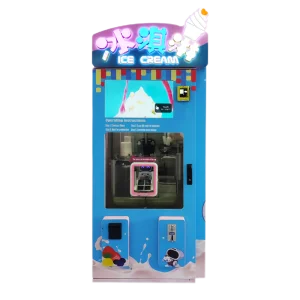
Diversify your unattended retail portfolio with our companion robotic food & beverage platforms.