Explore primary automated dispensing platforms engineered by China's leading vending machine companies for global unattended commercial operations.
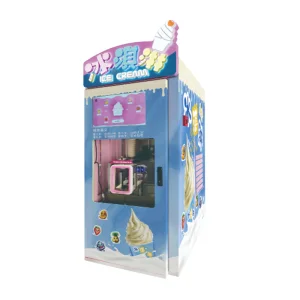

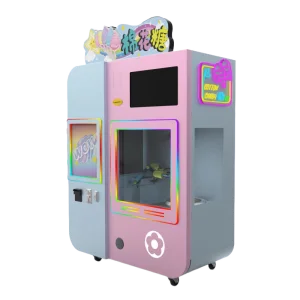

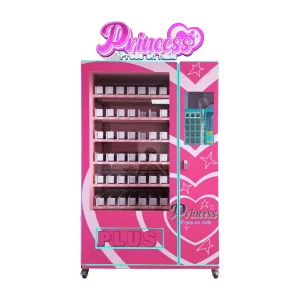
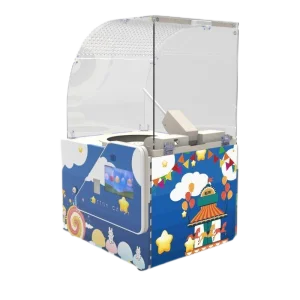
The commercial landscape of custom automatic vending machine companies has shifted from traditional mechanical drop-shelf boxes to highly sophisticated, robotic food-and-beverage preparation platforms. Modern enterprise operators, venue concessionaires, and vending brand owners require bespoke hardware-software integration capable of operating continuously in high-footfall, unattended environments.
Built with CNC-laser-cut galvanized steel chassis, heavy-duty industrial linear actuators, and sealed robotics grade servo motors. Engineering tolerances are strictly governed to withstand up to 100,000 continuous dispense cycles without structural failure.
From high-speed precision sugar spinning heads (operating up to 3,600 RPM with PID temperature control) to pressurized soft-serve refrigeration systems, our machines execute food-grade processing in seconds under zero human supervision.
Real-time telemetry streams operational data (raw material levels, boiler temperatures, internal humidity, power spikes, error logs) directly to an encrypted cloud control panel accessible via Web, iOS, and Android.
When global companies search for a custom vending machine automatic factory, China—specifically the industrial manufacturing hub in Panyu District, Guangzhou—stands out as the worldwide center for hardware innovation, component sourcing, and rapid industrialization.
Partnering directly with a source manufacturer like Guangzhou Seven Cloud Technology Co., Ltd. (SevenCloud / Qiyun) eliminates 25%–40% in middleman markup while providing direct access to the mechanical, firmware, and software engineers who build your machines. Our facility integrates sheet-metal stamping, powder coating, electrical harness assembly, robotic calibrating, and 24-hour burn-in test bays under a single ISO-structured umbrella.
| Evaluation Parameter | China Source Manufacturer (SevenCloud) | Third-Party Trading Companies | Western OEM Assemblers |
|---|---|---|---|
| Cost Structure | Factory-direct FOB/CIF pricing; optimal BOM cost | 30%–50% broker markups on hardware | High overhead, 2x–3.5x equipment cost |
| OEM/ODM Flexibility | Full structural sheet metal, UI software & PCB design | Limited to superficial sticker decals | High engineering fees, slow lead times |
| Supply Chain Integration | 100% localized component access within 50km radius | Fragmented procurement from secondary sources | Relies heavily on imported sub-assemblies |
| Burn-In & Quality Control | In-house 11-step QC & 24-hour non-stop burn-in | Visual spot-check upon warehouse pickup | Variable, third-party audit dependent |
| Technical Support | Direct engineering video diagnosis & component replacement | Relays messages with slow communication cycles | Localized but limited by component inventory |
The global automated retail sector is transitioning from passive product storage to active, experiential robotic micro-factories. To maintain competitive advantage, custom automated vending machine suppliers are integrating four macro trends:
Modern consumers, particularly Gen Z and young families, demand visual interaction. Transparent glass viewing windows combined with multi-axis robotic arms preparing soft-serve ice cream or spinning multi-colored flower cotton candy convert routine purchases into shareable social media moments.
Over 88% of unattended transactions worldwide occur via cashless terminals (Nayax, Ingenico, PAX) or mobile wallets (Apple Pay, Google Pay, WeChat Pay, KakaoPay). Integrated MDB/DEX protocol controllers ensure rapid transaction processing under 2 seconds.
Clean-In-Place (CIP) technology uses high-temperature automatic pasteurization, timed UV-C sterilization chambers, and automated water-rinse cycles to maintain strict food hygiene standards (FDA, EU Regulation 852/2004) without daily manual disassembly.
Scaling a network from 5 to 500 automated vending units requires robust back-end software architecture. A professional custom vending machine company does not merely sell hardware; it provides a comprehensive SaaS enterprise fleet management stack.
Importing commercial automated vending equipment requires total compliance with international electrical safety, food contact, and electromagnetic standards. Failure to secure regional certifications can lead to customs impoundment, venue rejection, or liability risks.
Mandatory Certifications:
ETL / cETL (UL 751 & NSF 25) for electrical safety and sanitation. NAMA (National Automatic Merchandising Association) compliance for food contact zones. 110V/60Hz voltage configurations with NEMA 5-15P plug standards.
Mandatory Certifications:
CE Marking covering Low Voltage Directive (LVD 2014/35/EU) and Electromagnetic Compatibility (EMC 2014/30/EU). RoHS 2.0 directive compliance verifying hazardous-substance-free construction. 230V/50Hz CE-certified power supplies.
Mandatory Certifications:
PSE Certification for Japan, KC Mark for South Korea, and CB Scheme Reports accepted across GCC and Middle East markets. Custom transformer modules supporting 100V, 220V, or 240V grids.
Selecting the right automated vending robot model depends heavily on venue footfall profile, customer dwell time, and demographic buying intent. Below are field-tested application scenarios:
Optimal Hardware: Fully Automatic Cotton Candy Vending Machine & Soft Serve Ice Cream Robot.
Revenue Dynamics: High footfall, weekend spikes, and strong child-driven impulse buying. Dynamic LED light shows and custom patterned cotton candy art create immediate crowd draw, driving high profit margins on low ingredient costs.
Optimal Hardware: High-Capacity SC-320 Cotton Candy Machines & Dual-Barrel Soft Serve Robots.
Revenue Dynamics: Sustained high-volume outdoor queues during peak holiday seasons. Machines operate continuously, delivering fast dispensings (under 60-90 seconds per unit) to handle peak visitor flows.
Optimal Hardware: P30 6-Flavor Popcorn Vending Machine & Semi-Automatic Cotton Candy Units.
Revenue Dynamics: High evening traffic and movie-goers seeking premium snacks. The P30’s kettle-style sugar and oil frying mechanism delivers fresh popcorn aromas that spark impulse purchases.
Optimal Hardware: Fresh Bean-to-Cup Coffee Vending Machines & P10 Sugar-Free Popcorn Units.
Revenue Dynamics: Consistent, year-round daily recurring purchases from office workers and travelers requiring quick, hygienic, high-quality coffee and light snacks around the clock.
Explore additional specialized, semi-automatic, and compact event vending equipment from our factory floor.
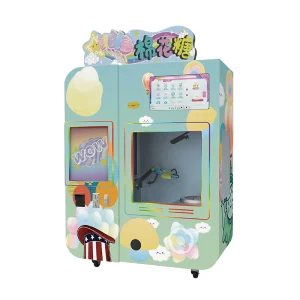
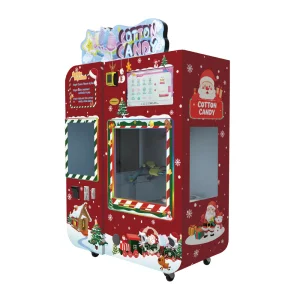
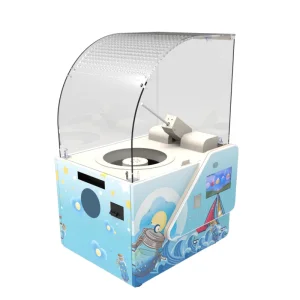

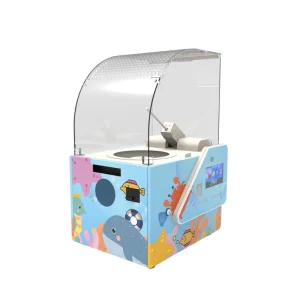
Direct technical insights and procurement answers provided by our senior engineering and export support teams.
We manufacture a comprehensive ecosystem of automated food-and-beverage robots: fully automatic cotton candy vending machines, robotic soft-serve ice cream vending machines, popcorn vending machines (P10 oil/sugar-free model and P30 6-flavor commercial model), bean-to-cup fresh coffee vending machines, semi-automatic commercial cotton candy units, mini event cotton candy machines, and industrial canned cotton candy automated filling lines.
The machine integrates payment processing, automated paper stick dispensing, high-speed burner temperature regulation, multi-axis robotic stick rotation, sugar dosing, and automated cabinet door opening. When a customer pays via touch screen or card reader, the internal robotic arm grips a stick, moves it around the spinning burner head to craft a designated 3D flower pattern, and presents the finished treat through a protective dispensing door.
The highest performing locations are indoor shopping mall corridors, theme parks, family entertainment centers (FECs), children's indoor play zones, aquariums, zoos, movie theaters, and high-footfall tourist boardwalks where dwell time is high and visual entertainment triggers impulse buys.
Soft-serve ice cream robots require a flat indoor footprint (approx. 1 to 1.5 sq meters), a dedicated power outlet (110V/60Hz or 220V/50Hz depending on region with 1.5kW-2.5kW peak draw during freezing cycles), ambient room temperature under 35°C, and access to potable water for periodic automated cleaning routines.
The P10 uses a hot-air popping technology requiring zero oil and zero sugar during the cooking phase, offering a lighter snack where customers apply external flavor seasoning packets. The P30 uses an automated commercial kettle oil-and-sugar frying mechanism that produces authentic, crunchy cinema-style popcorn across 6 customizable flavor channels.
Equipped with a commercial Swiss-blade grinder, high-pressure 19-bar espresso brewer, and multiple instant powder hoppers (milk powder, chocolate, matcha, vanilla), the machine can grind fresh beans and dispense up to 16 distinct hot and cold beverages including Espresso, Americano, Cappuccino, Latte, Hot Chocolate, and Mocha.
Yes. Semi-automatic units are engineered for staff-assisted counter execution in restaurants, KTVs, convenience stores, and party rental businesses. The staff member accepts payment and holds the stick while the automated internal head spins patterned cotton candy at the press of a button, minimizing labor skill requirements.
Confectionery brands, commercial food factories, wholesale snack packaging facilities, and novelty gift food companies utilize canned production lines. These automated industrial lines produce sealed, shelf-stable canned cotton candy at high volumes for wholesale distribution to supermarkets and retail chains.
We provide comprehensive OEM/ODM customization: full vinyl machine wraps and logo branding, custom exterior powder-coat paint colors, UI touchscreen graphic design, localized software language packages, customized payment terminal cutouts, regional voltage transformers, and bespoke mechanical housing modifications.
Our electronics support global MDB standard payment hardware including credit/debit card readers (Nayax, Ingenico, CPI), bill acceptors, coin mechanisms, QR code scanners, and mobile NFC payment systems (Apple Pay, Google Pay).
The IoT management cloud platform tracks real-time sales revenue, inventory depletion levels, mechanical system diagnostics, and operational temperature readings across all deployed machines. Operators receive automated alerts via SMS or email when inventory is low or maintenance is required.
Depending on model configuration, our equipment holds international compliance certifications including CE, ETL, cETL, NAMA, RoHS, PSE, KC, and CB scheme reports. Certificate documentation is provided during the official order quoting process.
Machines undergo an 11-step factory inspection and 24-hour burn-in test before packaging. Equipment is wrapped in moisture-barrier vacuum plastic, cushioned with thick shock-absorbing foam corner protection, and fully enclosed in reinforced fumigation-free wooden export crates built to withstand international ocean freight transit.
We offer a comprehensive 12-month hardware warranty on core components, dedicated online technical group support with factory engineers, instant video diagnostic guidance, fast air-express replacement parts delivery, and lifelong software firmware remote updates.
Buyers can contact our export team through our official sales email or direct phone channels. Our solution specialists assist in selecting the appropriate model, confirming regional electrical/payment specifications, generating a formal proforma invoice, and arranging door-to-door or door-to-port international shipping logistics.
