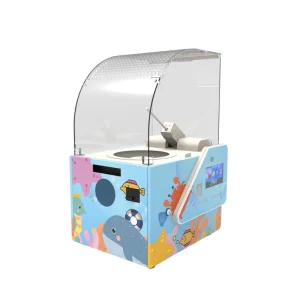
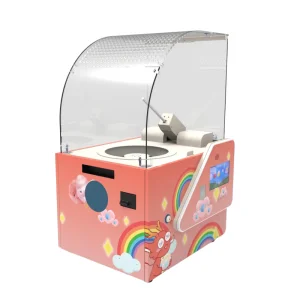
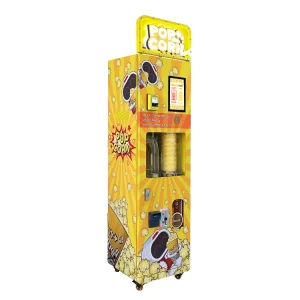
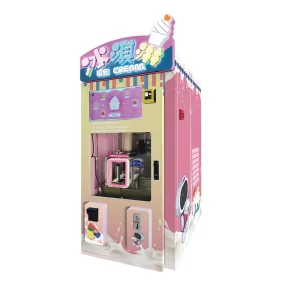
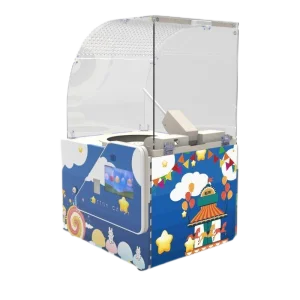
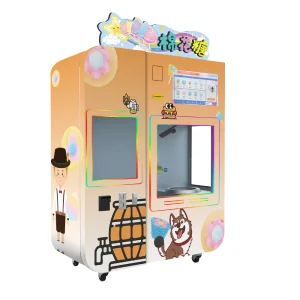
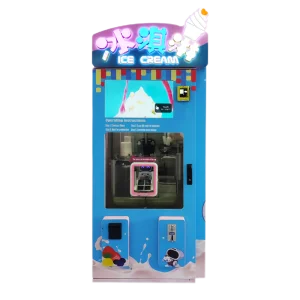
The global automated retail landscape has undergone a foundational paradigm shift. Legacy, dumb-terminal vending machines—reliant on mechanical relays and isolated bill validators—are systematically being phased out. Modern commercial operators no longer evaluate equipment purely by physical chassis size or mechanical payload. Instead, procurement directors demand software-defined vending architecture capable of edge computing, telemetry integration, dynamic price management, and predictive maintenance.
As customized automated food preparation equipment—such as 3D robotic cotton candy machines, soft-serve ice cream robots, smart popcorn dispensers, and automated coffee kiosks—gains market share, software complexity escalates exponentially. Controlling precise robotic kinematics, maintaining thermal stability, managing automated cleaning cycles, and executing real-time PCI-DSS compliant transactions require a harmonized ecosystem spanning microcontrollers, edge IPCs (Industrial PCs), and cloud microservices.
Real-time bidirectional communication over MQTT/WebSocket protocols ensures instant operational status monitoring, automated stock tracking, and immediate error diagnostic triggers across global machine fleets.
Custom software drivers interface with stepper motors, linear actuators, and multi-axis articulated arms to execute complex sugar-spinning, ice-cream dispensing, or cup-handling sequences with sub-millimeter fidelity.
Enterprise buyers require secure end-to-end data pipelines. Software stacks must guarantee tokenized payment handling, encrypted MDB bus communications, and secure Over-The-Air (OTA) firmware signing.
When global vending operators, franchise chains, and OEM distributors select a manufacturing supplier, software capability is frequently the single defining vector between long-term operational profitability and continuous field failure. Sourcing from a factory that relies on closed, unmodifiable third-party software creates structural vulnerabilities: vendor lock-in, unpatched security flaws, and zero control over UI localization or payment integration.
Senior Architect Insight: True OEM/ODM software suppliers do not merely flash Android APKs onto consumer tablets. Enterprise-grade smart vending requires industrial Linux or Android OS hardening, board-level RS232/RS485 MDB protocol control, isolated watchdog timers to recover from voltage spikes, and open RESTful/GraphQL API endpoints for ERP system integration (e.g., SAP, Salesforce, Microsoft Dynamics).
| Evaluation Parameter | Monolithic / Basic Software (Legacy) | Factory Custom Smart Software Stack (Next-Gen) |
|---|---|---|
| Architecture | Single-threaded APK, local storage only, zero cloud backplane | Containerized microservices, Cloud-Native, MQTT Edge Gateway |
| Robotic Kinematics | Fixed hard-coded delays, high failure rate under mechanical wear | Closed-loop sensor feedback, real-time PID motor calibration |
| Payment Integration | Locked to local country pulse-acceptor or single card reader | MDB 4.3 & DEX / UCS compliant; multi-gateway cashless API |
| OTA Updates | Manual USB technician flashing at physical site location | Automated, cryptographically signed remote delta updates |
| Multi-Tenant Management | Non-existent; single admin password for all machines | Role-Based Access Control (RBAC) with regional telemetry isolation |
Different automated vending verticals demand radically tailored software strategies. A soft-serve ice cream robot operates under thermal and hygienic constraints that do not apply to a popcorn dispenser or a fresh bean-to-cup coffee kiosk. Custom software factories must deliver optimized domain logic for each specific mechanical platform.
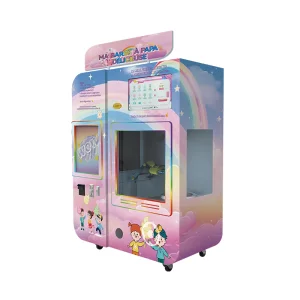
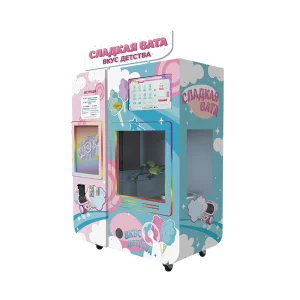
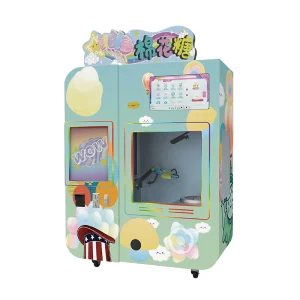
Automated cotton candy machines demand real-time environmental compensation algorithms. Relative humidity and room temperature alter sugar crystallization velocity. The software dynamically adjusts heating element wattage, spinning burner RPM, and robotic arm pathing to guarantee 3D flower-shaped design precision.
Hygienic safety compliance is paramount. Soft-serve ice cream software monitors pasteurization temperatures, controls compressor refrigeration loops, tracks cylinder viscosity via current sensors, and executes automated CIP (Clean-In-Place) timing protocols with automatic lock-outs if thermal boundaries are breached.
High-speed, multi-flavor selection requires intuitive touch-UI state machines. The software orchestrates precise volumetric raw ingredient dispensing, controls hot-air popping or bean-grinding mill duration, and synchronizes cup/bag delivery doors with anti-pinch infrared safety sensors.
Deploying smart vending hardware across North America, Europe, the Middle East, and Asia-Pacific presents massive regulatory and localized integration hurdles. Software must be engineered from the ground up with modular architecture, permitting rapid adaptation to local tax laws, UI languages, payment networks, and data privacy mandates.
Native integration for Nayax, CPI, Ingenico, Cantaloupe, Stripe, Apple Pay, Google Wallet, and regional QR systems (WeChat Pay, Alipay, PayTM, KakaoPay).
Dynamic language switching supporting 30+ languages including RTL (Right-to-Left) script layouts for Arabic and Hebrew, with localized voice guidance files.
Cloud management servers configured for localized data compliance (EU data residency in Frankfurt, US data in Virginia) with anonymized telemetry analytics.
Support for digital e-receipt generation via QR code scanning and direct integration with European fiscal printers (e.g., Italian AdE, Romanian ANAF compliance).
The future of smart vending lies in full autonomous self-optimization. Our software engineering teams are continuously pushing the boundaries of embedded micro-intelligence. Over the next 24 to 36 months, enterprise software evolution will center on three critical technological pillars:
By capturing high-frequency current signatures and vibration harmonics from motors and compressors, edge-based machine learning models predict component degradation (e.g., bearing wear or heating tube burnout) up to 14 days before catastrophic operational failure, scheduling automated dispatch tickets before revenue loss occurs.
Integrating high-speed optical camera modules inside automated production chambers (such as cotton candy or ice cream dispensing zones). Computer vision algorithms analyze visual symmetry, color distribution, and shape accuracy in real time, automatically discarding suboptimal creations and recalibrating motor paths.
Cloud platforms communicate directly with localized warehouse logistics systems. Machine learning models correlate historical foot-traffic data, weather forecasts, and local holiday events to predict raw material exhaustion rates (sugar, syrup, milk mix, cups), automatically generating optimized supply chain routing.
Technical, architectural, and commercial queries addressed by our Senior Software Engineering & Supply Chain Management Teams.
Yes. As a direct OEM/ODM software supplier and equipment factory, we provide complete white-label customization. This includes custom touchscreen UX/UI design, branded video animations, custom product selection trees, tailored promotional price tiers, and modified operational step-sequences (e.g., asking for customer phone numbers for loyalty points prior to dispense).
Our embedded industrial controllers feature hardware-level MDB (Multi-Drop Bus) 4.3 and DEX/UCS interface ports. The software firmware natively supports Executive, MDB, and RS232 protocols, enabling seamless plug-and-play communication with international credit card readers, cashless telemetry devices, bill validators, and coin acceptors without requiring external third-party converter boxes.
For enterprise fleet operators and large distributors, we provide open RESTful APIs, Webhook event triggers, and MQTT telemetry streams. This enables real-time synchronization of sales records, inventory depletion, temperature metrics, and maintenance alerts directly into your proprietary ERP platforms (such as SAP, Oracle NetSuite, or Microsoft Dynamics 365). Source code licensing agreements can be executed under dedicated enterprise OEM software contracts.
Our cloud management platform utilizes secure A/B dual-partition OTA deployment. When a firmware patch or feature update is pushed from our centralized servers, the machine downloads the update in the background. If any verification anomaly or power loss occurs during installation, the system automatically rolls back to the stable primary partition, eliminating field bricking and technician service calls.
The machine software operates on an "Offline-First" architecture. All critical execution routines—such as robotic kinematics, payment processing validation, temperature control loops, and safety door sensor monitoring—run locally on the machine’s industrial ARM/X86 motherboard. Transactions executed while offline are stored in encrypted SQLite databases and automatically synced to the cloud backplane once network connectivity resumes.