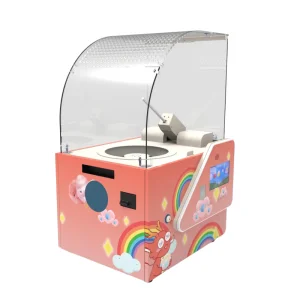
Explore our flagship CE-certified fully automated candy floss, soft-serve ice cream, and robotic beverage hardware platforms tailored for high-yield retail environments.
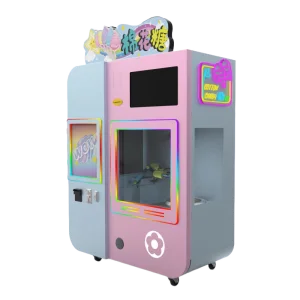
In the modern global retail framework, automated vending machines have transitioned from simple mechanical dispensers to complex, multi-axis robotic kiosks. For global enterprise buyers, purchasing equipment from a qualified CE Certification Vending Machine System Manufacturer & Company is not merely a legal import mandate; it is a critical safeguard for operational continuity, electrical safety, public health protection, and liability management.
CE marking (Conformité Européenne) indicates that an automated food vending machine complies with stringent European Union directives regarding structural engineering, electromagnetic compatibility, and consumer food contact safety. As an established original equipment manufacturer (OEM) headquartered in Guangzhou, China, our industrial ecosystem engineers vending systems aligned with three essential EU directives:
Guarantees structural steel integrity, pinch-point protection via light curtains, anti-entrapment robotic arms, and redundant emergency shutoff systems to eliminate risk to end-consumers.
Mandates high-grade insulation, creepage clearance, dual-pole circuit breakers, grounding continuity (<0.1Ω), and thermal overload cutouts for high-power heating elements and compressors.
Ensures that embedded microcontrollers, 4G/5G IoT telemetric units, and touch displays neither emit electromagnetic interference nor suffer malfunction near high-frequency commercial gear.
While low-cost assemblers rely on generic components, our ISO-9001 certified manufacturing facility integrates 304/316 food-grade stainless steel hoppers, anti-microbial silicone tubing, peristaltic dosing pumps, and sealed optical encoders. Every machine undergo 11 distinct QC protocols including a mandatory 24-hour continuous burn-in and a 200-unit stress test prior to international crating.
The global automated vending machine market is experiencing a structural shift driven by three primary forces: persistent hospitality labor shortages, rising real estate costs in high-footfall urban centers, and evolving consumer demand for instant, hygienic, visual entertainment dining experiences.
Traditional passive vending machines (vending packaged chips or canned sodas) generate low unit margins and suffer from declining consumer engagement. In contrast, robotic micro-factories—such as fully automated cotton candy spinners, robotic soft-serve stations, air-popped popcorn units, and bean-to-cup espresso systems—deliver prepared-on-demand products with gross margins often exceeding 80% to 90%.
Modern consumers, particularly Gen Z and millennial families, demand experiential purchasing. Machines equipped with 3D robotic arms, transparent tempered-glass windows, and RGB LED synchronization turn the food production sequence into a visual performance, capturing foot traffic organically without advertising spend.
Enterprise operators no longer manage single machines; they operate regional fleets. Cloud-connected microcontrollers transmit real-time telemetry regarding sugar humidity levels, ice cream mix temperatures, motor torque load, inventory counts, and cashless transaction logs directly to centralized management portals.
Procurement directors from commercial arcade chains, theme parks, shopping mall syndicates, and vending franchise operators evaluate vending hardware using rigorous Total Cost of Ownership (TCO) matrices. A competitive acquisition cost must be backed by long-term structural reliability, low maintenance overhead, and rapid ROI payback.
| Evaluation Vector | Legacy Vending Systems | SevenCloud Advanced Robotic Platforms | Operational Business Impact |
|---|---|---|---|
| Robotic Precision | Open-loop steppers; prone to mechanical jams. | Closed-loop servo drives with optical encoders. | Reduces dispenser mechanical failure rates by 94%. |
| Payment Integration | Single-coin/bill validation hardware. | MDB standard; Nayax, CPI, QR, Credit Card, Apple Pay. | Maximizes global transaction conversion across demographics. |
| Sanitation Automation | Manual disassemble required daily. | CIP (Clean-in-Place) automated high-temp wash cycles. | Saves 1.5 labor hours per day per machine location. |
| Environmental Control | None; sugar clumping occurs in humid climates. | Internal dehumidification + constant temperature loop. | Ensures 100% operational uptime in tropical/coastal zones. |
| Software Remote Management | Local error codes on 7-segment displays. | IoT Cloud Web Dashboard + Mobile Alerts + OTA updates. | Enables remote troubleshooting, lowering truck-rolls. |
Guangzhou, Guangdong has established itself as the world's premier cluster for commercial intelligence equipment, smart hardware fabrication, and unmanned retail robotics. Operating an 11,000 m² integrated production plant within this ecosystem provides distinct competitive advantages that directly benefit our global OEM/ODM enterprise clients:
From in-house fiber-laser metal cutting, robotic bending, and powder coating to PCB mounting, wire harness fabrication, and final system integration, controlling 100% of the manufacturing chain ensures strict quality management and fast lead times.
Proximity to Tier-1 suppliers for compressors (Embraco/Secop), touch panels, bill validators, and food-grade plastics allows us to quickly prototype, iterate custom engineering designs, and scale production volume dynamically.
Our quality control matrix encompasses incoming material stress tests, subassembly electrical testing, high-voltage insulation breakdown tests, transport vibration simulation, and 200-unit uninterrupted vending sequence tests.
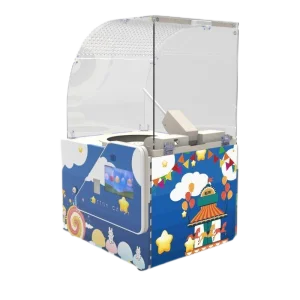
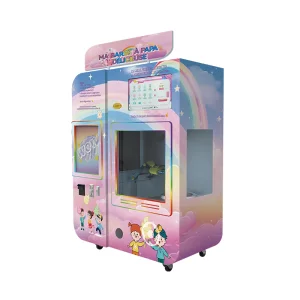
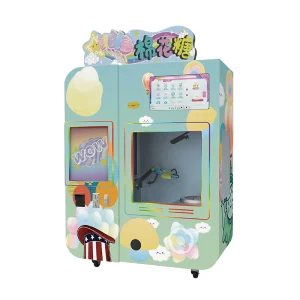
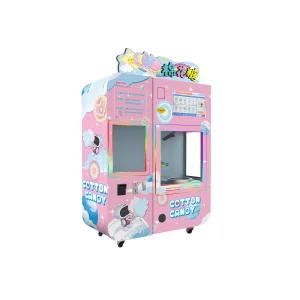
Our fully automatic cotton candy vending platforms (such as the SC-320 and SC-320A series) feature a high-speed heating atomization burner driven by precise PID temperature controllers. A multi-axis robotic arm grabs a paper stick, moves in coordinated XYZ coordinates around the burner, and creates up to 30 unique multi-colored 3D floral and geometric shapes.
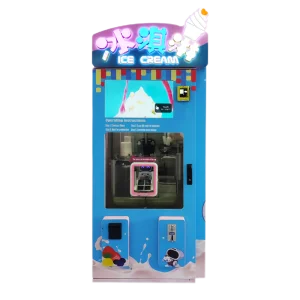
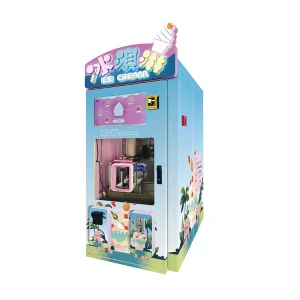
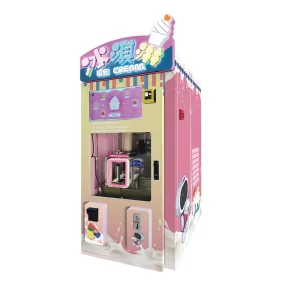
Robotic soft-serve machines require strict hygiene and temperature controls. Our automated ice cream vending systems feature dual-compressor pasteurization loops that maintain liquid mix at a safe 2°C to 4°C continuously. Upon user selection, a servo-driven piston dispenses accurate volume while a rotary table creates perfect soft-serve swirls.
Strategic machine placement directly impacts daily throughput and payback periods. Our global client base has successfully deployed CE-certified automated vending equipment across diverse high-density real estate categories:
Primary Model: Fully Automatic Cotton Candy SC-320 / Ice Cream Robots.
High family volume creates constant impulse buys along queue lines and exit pathways. Visual movement draws waiting crowds automatically.
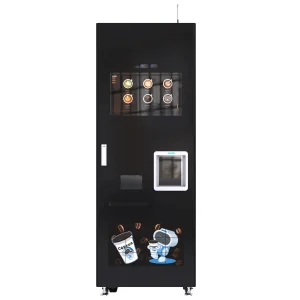
Primary Model: SC-320A / Coffee SF308 / Popcorn P30.
Provides mall operators with an interactive food kiosk using under 2 m² of floor space, requiring zero water line plumbing due to internal tanks.
Primary Model: Mini SC-221 / Semi-Auto Models / Popcorn P10.
Complements game room redemption centers, giving card swipe integration and generating high-margin snack revenue on existing foot traffic.
Primary Model: Fresh Coffee Vending / Ice Cream Vending Systems.
24/7 continuous operation caters to late-night travelers when traditional concession stands are closed, maximizing off-peak revenue.
Discover specialized models optimized for variable footprint constraints, specialized retail menus, and batch manufacturing capabilities.
Partner directly with a leading Guangzhou OEM manufacturer. Request comprehensive CE compliance dossiers, technical CAD drawings, FOB/CIF container freight estimates, and factory volume pricing.