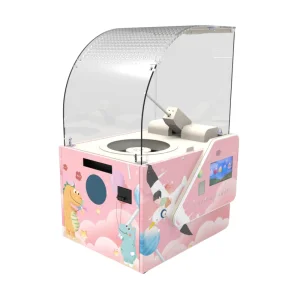
Explore our flagship CE-certified fully automated cotton candy, soft-serve ice cream, and popcorn vending robots designed for 24/7 continuous profit generation.
The global automated vending machine market has undergone a profound structural metamorphosis over the past decade. Legacy vending platforms—historically constrained to static snack coils and canned beverage dispensers—are rapidly yielding market share to interactive, robo-robotic food processing terminals. According to global retail automation statistics, the demand for on-demand, freshly prepared sweet treats such as cotton candy, soft-serve ice cream, and gourmet popcorn has surged at a compound annual growth rate (CAGR) exceeding 14.8%.
This industrial evolution is fundamentally propelled by three core macro-economic drivers: rising minimum wage costs in high-income regions, shifting consumer preferences toward theatrical, experience-driven retail, and the imperative for 24/7 unstaffed revenue generation. However, scaling a network of autonomous vending terminals across international jurisdictions requires more than aesthetic appeal; it demands robust engineering compliance, rigid quality assurance, and absolute adherence to international safety standards.
For enterprise buyers, importers, and chain operators, securing valid CE (Conformité Européenne) Certification is not merely a legal prerequisite for entering the European Economic Area (EEA); it represents an exhaustive engineering validation of electrical, mechanical, and food contact safety. Authentic CE compliance for food vending machinery encompasses multi-directive harmonized standards that guard against operational hazards, structural failures, and food safety breaches.
Governs robotic motion, mechanical arms, heating elements, and rotating burners (such as cotton candy sugar centrifuges operating at 3,000+ RPM). Mandates fail-safe interlocks, emergency stop circuits, photoelectric anti-pinch sensors, and structural integrity under peak mechanical load.
Regulates electrical safety for internal power supplies, transformers, heating coils, and refrigeration compressors operating between 50V–1000V AC. Ensures robust insulation resistance, ground fault protection, and prevention of thermal arc risks during continuous 24/7 cycles.
Guarantees Electromagnetic Compatibility. Prevents high-frequency power electronics, bill acceptors, and touchscreens from radiating electromagnetic interference (EMI) while ensuring resistance against electrostatic discharges (ESD) and external power fluctuations.
A critical compliance area often overlooked by lower-tier manufacturers is food hygiene security. CE-certified vending machinery built by leading factories utilizes exclusively food-grade Stainless Steel (SUS304/SUS316) for internal hoppers, food-grade PTFE non-stick coatings, and non-toxic silicone tubing. Automatic water-dispensing Clean-in-Place (CIP) systems ensure that humid dispensing chambers, ice cream hoppers, and sugar bowls remain sterile, meeting stringent international Hazard Analysis Critical Control Point (HACCP) criteria.
| Global Region | Key Regulatory Directives | Critical Safety Focus Areas | Enterprise Import Impact |
|---|---|---|---|
| European Union (EEA) | CE (2006/42/EC, LVD, EMC), RoHS, REACH | Robotic kinematics, eco-hazardous substance ban, EMI radiation | Mandatory customs clearance requirement across 27 EU member states. |
| North America | ETL / UL 751, NAMA, FCC Part 15, NSF 25 | Fire risk insulation, food sanitation design, coin/bill security | Required for commercial placement in tier-1 US shopping malls & theme parks. |
| Japan & South Korea | PSE Mark (Electrical Safety Law), KC Certificate | Grid frequency stability (50Hz/60Hz), high-humidity circuit potting | Essential for commercial distributor licensing and municipal placement. |
| Global / International | CB Scheme, ISO 9001:2015 Manufacturing Quality | Harmonized electrotechnical test reports across 50+ countries | Streamlines localized homologation and dramatically lowers import duty risks. |
When enterprise procurement directors and franchise fleet operators evaluate vending equipment manufacturers in China, the decision matrix must extend beyond initial FOB equipment purchase price. A complete Total Cost of Ownership (TCO) assessment incorporates unit raw material consumption, scheduled maintenance labor, telemetry software licensing, fault downtime rates, and machine lifespan depreciation.
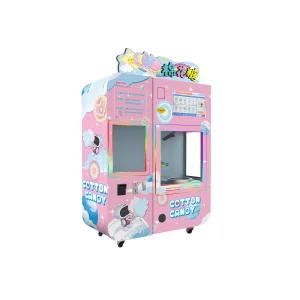
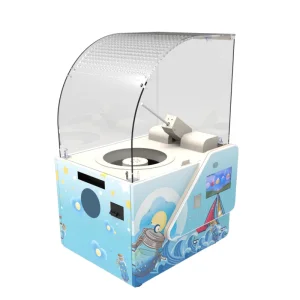
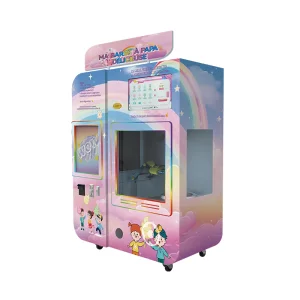
A fully automatic cotton candy vending robot (e.g., SC-320A series) converts approximately 30 grams of specialized sugar and a paper stick into a complex 3D flower pattern in 60 to 90 seconds.
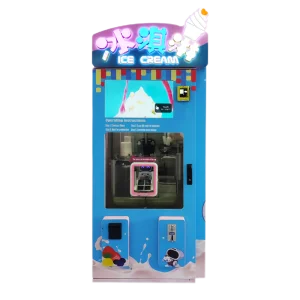
Unmanned soft-serve ice cream terminals (e.g., SI-321 series) combine pasteurized liquid mix, topping dispensers, and robotic cup dispensing in an environmentally controlled pasteurization enclosure.
Procuring directly from established OEM/ODM manufacturing facilities (such as Guangzhou Seven Cloud Technology Co., Ltd.) yields quantifiable strategic advantages over trading agencies:
Direct modification of machine chassis, custom payment protocol integration (MDB, Nayax, Ingenico, QR codes), localized voltage transformer wiring (110V/220V), and specialized brand wrapping.
Direct access to core mechanical component replacements, electrical wiring diagrams, firmware source updates, and dedicated engineering support groups during field malfunctions.
Elimination of middleman markup layers (typically 25%–40%), securing factory-direct bulk tier pricing, and direct containerized export loading protection.
Modern commercial vending machines are no longer standalone electromechanical units; they operate as edge-computing IoT nodes connected to centralized cloud telemetry platforms. This technological convergence enables real-time inventory management, automated fault detection, and remote software deployment across global machine fleets.
The proprietary IoT software architecture allows operator network control via web portals and mobile applications. Key real-time functionalities include:
High-precision servo motors and multi-axis mechanical arms are engineered to execute intricate motions required for custom cotton candy shapes (e.g., 3D flowers, hearts) and smooth, consistent soft-serve ice cream dispensing without human intervention.
Selecting the optimal machine configuration depends heavily on site logistics, foot traffic demographics, electrical infrastructure, and dwell time dynamics.
Optimal Terminal: Fully Automatic 3D Cotton Candy Robot & Robotic Soft-Serve Terminal.
Value Proposition: High visual theatrical impact captures queuing families. RGB LED illuminated glass windows turn food preparation into an entertaining spectacle.
Optimal Terminal: Compact Footprint Ice Cream & Popcorn Vending Terminals.
Value Proposition: Minimal square footage footprint (< 1.5 sq meters) delivers maximum rental revenue per square meter with 24/7 autonomous uptime.
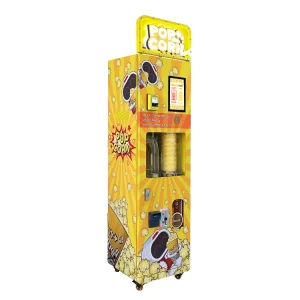
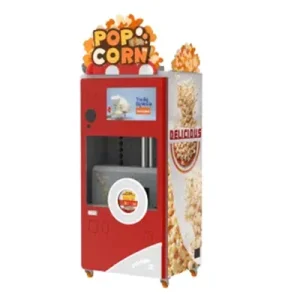
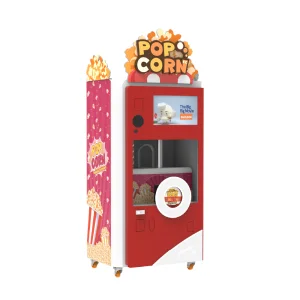
Optimal Terminal: Multi-Flavor Automatic Popcorn Vending Machine (P30 Series).
Value Proposition: Relieves peak-hour concession stand bottlenecks with instant, fresh oil-popped hot popcorn dispensed in under 45 seconds.
As a premier source manufacturer operating an 11,000 m² modern industrial facility in Guangzhou, China, Guangzhou Seven Cloud Technology Co., Ltd. (SevenCloud / Qiyun) enforces a rigorous 11-step Quality Control (QC) framework. Unattended equipment must perform flawlessly in distant markets without on-site technical supervisors, making factory stress testing paramount.
Incoming raw sheet metal, electronic IC boards, compressors, and motor components undergo strict dimensional tolerance, voltage stability, and food-grade compliance checks.
Sub-assembly testing of robotic arms, burner assemblies, touchscreens, and cooling loops before integration into the main chassis framework.
Every assembled machine undergoes a continuous 24-hour electrical and thermal burn-in cycle to identify early component failures before packaging.
Continuous, automated dispense testing of 200 consecutive product cycles to validate mechanical repeatability, sensor timing, and zero dispensing jams.
Exporting sensitive electromechanical robotics internationally requires heavy-duty protection against oceanic moisture, shock, and vibration during transit.
Machines are vacuum-sealed with anti-moisture desiccant bags, wrapped in multi-layer shock-absorbing foam, and enclosed in fully fumigated ISPM-15 wooden crates with reinforced steel corner brackets.
Dedicated online technical groups connect buyers directly with bilingual factory engineers for rapid video diagnostics, error log analysis, and step-by-step repair instruction.
Comprehensive 12-month factory warranty covering core electronics, motors, and heating elements. Express air delivery replacement parts shipment SLA guarantees minimal venue downtime.
Comprehensive technical insights directly addressing importer and operator queries regarding commercial food vending machinery.
Valid CE certification for automated food vending robots requires compliance with the Machinery Directive (2006/42/EC) for robotic motion safety, the Low Voltage Directive (LVD 2014/35/EU) for electrical safety, the Electromagnetic Compatibility Directive (EMC 2014/30/EU) to prevent signal interference, and Regulation (EC) No 1935/2004 for materials contacting food.
Commercial-grade cotton candy machines feature enclosed temperature- and humidity-controlled dispensing cabins. Integrated atomization systems adjust moisture levels dynamically, while automated thermal cleaning cycles flush the spinning burner head after designated dispensing cycles to prevent caramelization and sugar buildup.
Yes. Our vending terminals support international MDB protocols and can be equipped with cashless credit card readers (Nayax, Ingenico, PAX), bill acceptors (Cashcode, ICT), coin mechanisms, and regional mobile wallet QR code systems (Apple Pay, Google Pay, Alipay, WeChat Pay, local banking apps).
Featuring automated overnight heat-treatment pasteurization systems, liquid ice cream mix can safely remain in the refrigerated hopper for up to 7–14 days before requiring a full manual wash cycle, drastically reducing routine daily maintenance labor.
Machines can be factory-configured for global power grids, supporting 110V/60Hz (North America, Taiwan), 220V/50Hz (Europe, China, Southeast Asia), or 220V/60Hz (South Korea, Philippines) with market-specific heavy-duty industrial plugs.
Complete your automated concession fleet with our high-capacity popcorn machines, event models, and industrial packaging production lines.