Best Commercial Candy Floss Machines in 2026

Time:2026-11-23 Author:Sienna
0%

The best commercial candy floss machine in 2026 is not simply the fastest model on a product page. It is the machine that can handle your busiest service without producing uneven cones, excessive waste, or avoidable downtime. Commercial Candy Floss buyers should compare hourly output, bowl diameter, heat control, cleaning access, and parts availability. These details matter when a queue forms beside the counter and sugar begins to cling around the spinner head.

A useful expert quotation should be verified before publication. Insert a confirmed industry specialist’s name here: “[Expert Name], a commercial concession-equipment specialist, says, ‘Choose a machine for the rush you actually serve, not the output claimed on its box.’” Treat that line as draft copy, not a sourced quotation, until the expert approves it. This distinction matters. Credibility should not be spun like sugar.

This guide compares leading machines for fairs, cinemas, food trucks, and fixed concession stands. It considers warm-up time, consistent floss production, operator safety features, portability, and the practical effort required after closing. Some machines look impressive in a showroom but feel cumbersome on a cramped worktop. Others are easier to maintain, yet may struggle during a sustained rush. No single model suits every venue. The right choice depends on your serving volume, available counter space, staff experience, and budget. A few trade-offs remain. That is worth admitting.
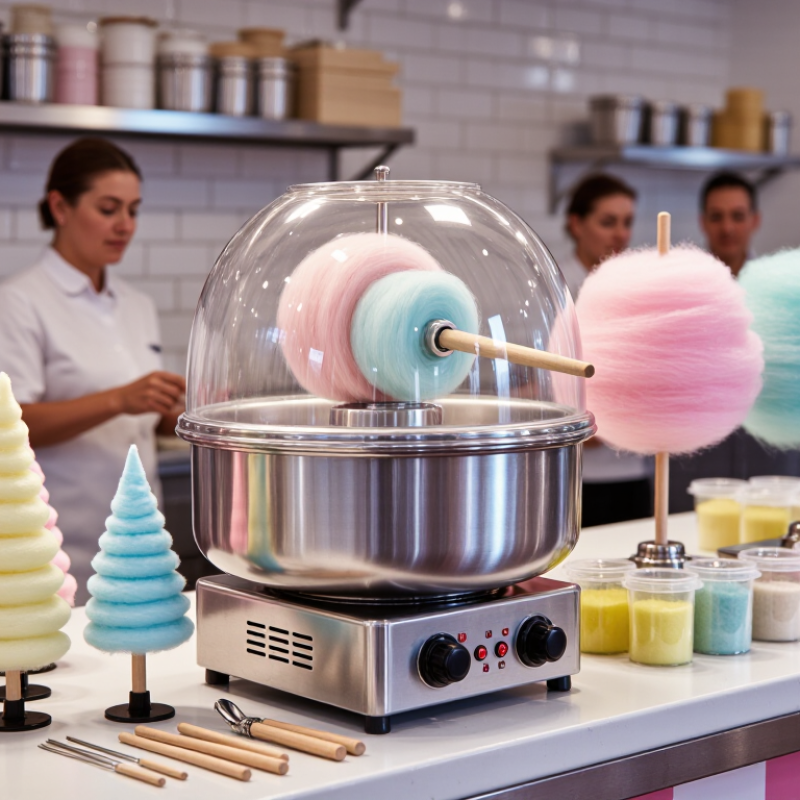
Best Commercial Candy Floss Machines in 2026

What Defines a Commercial Candy Floss Machine?

A commercial candy floss machine is designed for repeated service, not occasional kitchen use. Its heated spinning head melts sugar and draws fine strands into a large bowl, where an operator gathers them onto a cone. In a busy venue, stable heat, quick recovery, and easy cleaning matter more than a flashy maximum-output figure. Ask how the machine performs across consecutive batches, not just one test run.

A 2024 Grand View Research report put the global cotton candy market near US$3.1 billion in 2023 and projected continued growth through 2030. That signals broad demand, but it does not mean every venue needs the biggest machine. Match output to expected queues, available counter space, and the operator’s skill. A unit that produces quickly but splashes sugar onto nearby surfaces can slow service instead.

Check the bowl’s working diameter, electrical requirements, controls, and access to wear parts. Food-contact materials should be documented; shiny metal alone proves little. Removable parts and smooth surfaces make cleanup easier between shifts. Ask the supplier about continuous-use limits and head recovery time. Small detail. Big difference. I would also leave room for a learning curve: even capable equipment can produce uneven floss until staff find a steady pouring and gathering rhythm.

How Commercial Candy Floss Machines Produce Floss

A commercial candy floss machine heats granulated sugar inside a rotating metal head. As the sugar melts, centrifugal force pushes it through tiny openings. The strands cool quickly in the surrounding air, then collect as a soft web around a paper cone. Heat matters. Too little leaves coarse crystals; too much can darken the sugar and create a burnt taste.

Operators usually add a measured scoop after the head reaches its working temperature. Dry sugar and a steady rotation help produce finer, more even strands. The USDA’s November 2024 Sugar: World Markets and Trade report forecast global sugar production of 186.6 million metric tons for 2024/25. That figure describes supply, not machine output, but it highlights the scale of the ingredient behind this simple-looking process.

For commercial settings, output also depends on warm-up time, serving size, and how often the operator pauses to clean the head. The National Restaurant Association’s 2025 State of the Restaurant Industry projected U.S. restaurant sales of $1.5 trillion for 2025; this is broad foodservice context, not a forecast for candy floss sales. One detail is easy to miss: a machine can spin well while producing inconsistent floss if sugar is damp or the head is not clean. Temperature checks help, though they do not replace hands-on testing.

Best Commercial Candy Floss Machines in 2026 — How Commercial Candy Floss Machines Produce Floss

Machine Type Typical Bowl Diameter Typical Heater Power Indicative Output How It Produces Floss Best-Suited Setting Practical Considerations
Compact commercial countertop Approximately 18–20 in (46–51 cm) Often around 900–1,200 W About 1–2 servings per minute under suitable operating conditions A heated spinning head melts sugar and forces it through small openings. The sugar cools into fine strands as it leaves the head and is collected on a cone or stick. Small concession counters, cafés, and occasional events Uses less counter space, but its smaller bowl and heating capacity may limit sustained service speed.
Standard commercial countertop Approximately 20–22 in (51–56 cm) Often around 1,000–1,500 W About 2–3 servings per minute under suitable operating conditions The operator adds floss sugar to the central spinning head. Centrifugal force moves melted sugar through the head’s openings, where it cools into strands that are gathered around a cone or stick. Food stalls, fairs, school events, and medium-volume concessions A versatile format; output depends on warm-up time, operator technique, sugar, and working conditions.
High-output commercial unit Approximately 26–28 in (66–71 cm) Often around 1,500–2,000 W Can reach roughly 3–5 servings per minute in well-managed service A larger spinning head and stronger heating system can support faster, continuous production. Melted sugar is expelled as fine filaments and spun into a serving as the operator moves the cone around the bowl. Busy fairs, amusement venues, and high-volume concessions Requires more counter space and may need a suitable electrical circuit. Actual throughput is not guaranteed and varies with workload and operator skill.
Commercial cart-mounted unit Commonly around 20–26 in (51–66 cm), depending on the cart and machine Varies by the machine fitted to the cart; commonly about 1,000–1,800 W Typically comparable to the fitted machine, often about 2–4 servings per minute The floss-making process is the same as with a countertop unit: a heated head melts sugar and spins it through small openings, forming strands that are collected in the bowl. Mobile vending, outdoor events, and temporary concession areas Check cart stability, storage, transport access, and the power supply required by the fitted machine.

How the process works: Candy floss is made by heating sugar until it melts, then spinning the liquid sugar through tiny openings. As the thin streams cool in the surrounding air, they become fine sugar threads that are gathered into a serving. Figures above are indicative ranges for machine categories, not guaranteed specifications; capacity and performance vary by model, sugar, operator, maintenance, and operating conditions.

Key Features to Compare in 2026 Models

For 2026 commercial candy floss machines, compare real working capacity, not glossy product photos. Check the stated servings per hour against your expected rush, and ask how the figure was tested. A machine that handles one steady queue may struggle through repeated batches. Small details matter.

Compare bowl diameter, heat-up time, temperature control, and rated duty cycle. A wider bowl can help contain flying sugar, but it also takes more counter space. Confirm the voltage, plug type, and power draw suit your site before ordering. Look for a removable bowl and easy access around the spinner head; dried sugar there is tedious to clean. Noise matters, too.

Check frame stability, guard design, and whether replacement heating elements are available. Ask for clear care instructions and a practical warranty process, not just an impressive warranty length. If possible, watch a demonstration with your usual floss sugar and serving cones. Output can change with humidity and operator technique, so published figures are only a starting point. Testing in your own setup takes extra effort, but gives a more useful comparison.

Best Commercial Candy Floss Machines in 2026

The best commercial candy floss machines in 2026 are not simply the fastest models. They should heat evenly, recover quickly between servings, and stay stable during a busy service. A practical machine has a stainless-steel bowl with enough room for the operator to work without scattering sugar across the counter. Check the rated output against your real queue, not a best-case figure from a product sheet. Small details matter. A removable bowl, accessible controls, and a clear cleaning routine can save time after a long shift.

Consider where the machine will run. A compact unit may suit a café counter, while an event stand may need greater output and a sturdy cart. Confirm the electrical requirements, warm-up time, and availability of replacement parts before buying. Ask how the heating head is cleaned; hardened sugar can affect performance if maintenance is rushed. Not always obvious. Noise, heat around the operator, and the space needed for spun sugar deserve attention too. A higher price does not guarantee a better fit, and advertised serving rates may be optimistic. Compare warranty terms and service support, then choose a machine your staff can operate consistently.

How to Choose and Maintain a Commercial Machine

Choosing a commercial candy floss machine starts with the work it must handle. Estimate servings per hour, then compare that need with the machine’s stated output. A busy event may need a larger bowl and steady production, while a compact unit can suit a small counter. Bigger is not always better. Check the available counter space, power requirements, and whether the spinning head and bowl can be removed for cleaning. Read the operating manual before buying; advertised capacity does not tell the whole story.

Maintenance affects both performance and serving quality. Let the machine cool, switch it off, and unplug it before cleaning. Remove sugar residue from the bowl and accessible parts as directed in the manual. Sticky buildup can make later cleaning harder. Keep water away from electrical components, and never pour water over a hot spinning head. Small checks matter: inspect the power cord, confirm parts are secure, and listen for unusual vibration before service. Keep a soft cloth and the correct cleaning tools nearby.

Sugar behaves differently with humidity, so a dry storage area helps prevent clumps. Use the recommended sugar type and avoid overfilling the head. Not every problem is a machine fault; temperature, airflow, and technique can affect the floss. That can be frustrating. Keep a simple maintenance log, even if it feels fussy, noting cleaning dates and any changes in spinning or heating.

Best Commercial Candy Floss Machines in 2026: How to Choose and Maintain One

Suggested maintenance frequency for a machine used daily: clean the bowl after each day of use, inspect the floss head and drive belt weekly, and check the power cable monthly. These are general recommendations, not manufacturer specifications; adjust for usage and follow the machine’s manual.

FAQS

How should I choose a machine’s production capacity?

Estimate your real servings per hour, then compare that figure with the stated output. Product figures may reflect ideal conditions. I still find them easy to overtrust.

Is a larger machine always better for busy events?

Not necessarily. A larger bowl may suit a steady event queue, while a compact unit can fit a café counter. Bigger is not always better.

Which design details make daily use easier?

Look for a stable setup, accessible controls, and a removable bowl. Stainless steel can be practical. Small details matter.

What should I check before buying?

Confirm counter space, electrical requirements, warm-up time, replacement-part availability, warranty terms, and service support. Check the room around the machine too.

How do I clean the machine safely?

Switch it off, unplug it, and let it cool first. Remove residue from accessible parts as the manual directs. Keep water away from electrical components.

How can I prevent sugar from clumping?

Store sugar in a dry area and use the recommended type. Avoid overfilling the spinning head. Humidity can change how sugar behaves.

What might cause uneven candy floss?

The machine may not be the only cause. Temperature, airflow, sugar, and technique can all affect the result. Not always obvious.

What should I check before service?

Inspect the power cord, secure parts, and listen for unusual vibration. Keep a simple log of cleaning dates and performance changes. It can feel fussy.

Conclusion

Commercial Candy Floss machines are designed for frequent use in settings such as fairs, events, and food-service businesses. This guide explains what sets commercial models apart, including their capacity, durability, ease of operation, and suitability for different levels of demand. It also outlines how heated sugar is spun into fine strands and shaped into fluffy floss, helping readers understand the basic process before comparing equipment.

The 2026 comparison focuses on practical features such as heating performance, spinning-head design, cleaning requirements, portability, and overall ease of maintenance. Readers will find guidance on choosing a machine that fits their workload, workspace, and budget, along with straightforward care tips to support consistent operation. Whether you are new to Commercial Candy Floss production or upgrading existing equipment, the article offers a useful framework for making an informed choice.


Sienna

Sienna

Sienna is a skilled marketing professional with a deep expertise in our company’s core products and services. With a passion for innovation and detail, she plays a pivotal role in crafting insightful blog posts that not only highlight the unique features of our offerings but also provide valuable......